

2024
Bend had no permitting roadmap. My team wrote the first one.
Role
Senior UX Designer
Team Size
3
Platform
Web
Tool Stack
Optimal Workshop / Google Analytics / Miro / Microsoft CoPilot / Figma / GovAccess
Note: This case study describes work performed in my professional role at the City of Bend. This site is not affiliated with or endorsed by the City.Opportunity
Community members coming to the City's website to navigate the permitting process had no clear place to start: neither the overall process nor its requirements were outlined anywhere on the site.
Research
As part of an early-stage website redesign effort, we partnered with research firm Sitecrafting and took a human-centered design approach to understand how the Bend community used the website—the tasks they were trying to complete, where they were getting stuck, and how the site could better serve them. To accomplish this, we employed the following research methods:
Google Analytics
Stakeholder Workshops
Community Survey
On-Site Feedback Collector
Top-Task Analysis
Tree Testing
The research consistently pointed to the same frustration: community members didn't know how to get a permit, what documentation to gather, how long the process would take, or even whether they needed a permit at all. Frontline staff confirmed this pattern, reporting that these were among the most common questions they fielded by phone. The on-site feedback collector surfaced the same theme. The signal was clear and consistent: people were coming to the site for help with permitting and leaving without answers.
Context & Constraints
With a clear problem identified, we turned to understanding the environment we'd be designing within.
Content Architecture
The site's information architecture mirrored the department's internal organizational structure — individual pages devoted to each division and their specific area of responsibility. But community members don't think in departments and divisions. They think in terms of the task they're trying to complete or the service they're looking for. As a result, there was no clear starting point and no roadmap guiding community members through the permitting process from beginning to end.
Technology Limitations
Some of the frustrations we heard from the community revolved around the permitting software the City utilized, which was out of scope for our project. Additionally, the content management system our site was built on was overly rigid and didn't allow the flexibility to do any major UI overhauls.
Time
Due to an aggressive deadline set by the City Council and senior leadership, some pieces of the project had to be shelved for a later date.
Implementation
Recognizing early on that changes to a site staff rely on daily could create anxiety — particularly around losing familiar content or having to relearn navigation — we made stakeholder engagement a core part of our methodology rather than an afterthought. We prioritized building trust and buy-in through strong, open, two-way communication throughout the process.
We started with an introductory meeting with all stakeholders — the department director, division managers, and the content specialist designated to facilitate content reviews with subject matter experts as we moved through the project. We then held separate discovery sessions with each division to:
Get a better sense of what they do.
Hear directly from them what the most common questions they receive from the community are.
Ask what they would like to see on the site.
Sitemapping
Ahead of our first meeting with the department, I built out the sitemap for the current state of the site.
I then audited each page to determine what should stay, what should be combined, and what should go. From there, I began reorganizing the pages that would remain and incorporated new pages into the sitemap. After several iterations, I landed on a sitemap that my team and I felt more closely aligned with the expectations of the community.
This new sitemap included a significant amount of brand new content. Because the stakeholders were not familiar with sitemaps, I opted to build a proof-of-concept for one critical path I had envisioned — to make the direction tangible before asking stakeholders to commit to it.
Proof-of-Concept
What was completely missing from the site was an end-to-end outline of the permitting process. I believed that if we could establish this foundation, we would eliminate much of the confusion and frustration surfaced in our research.
The challenge was that nowhere on the site was the overall permitting process outlined end-to-end. Without that foundation, there was no clear place to start building.
So I enlisted the help of AI.
The City Greenlights Microsoft Copilot
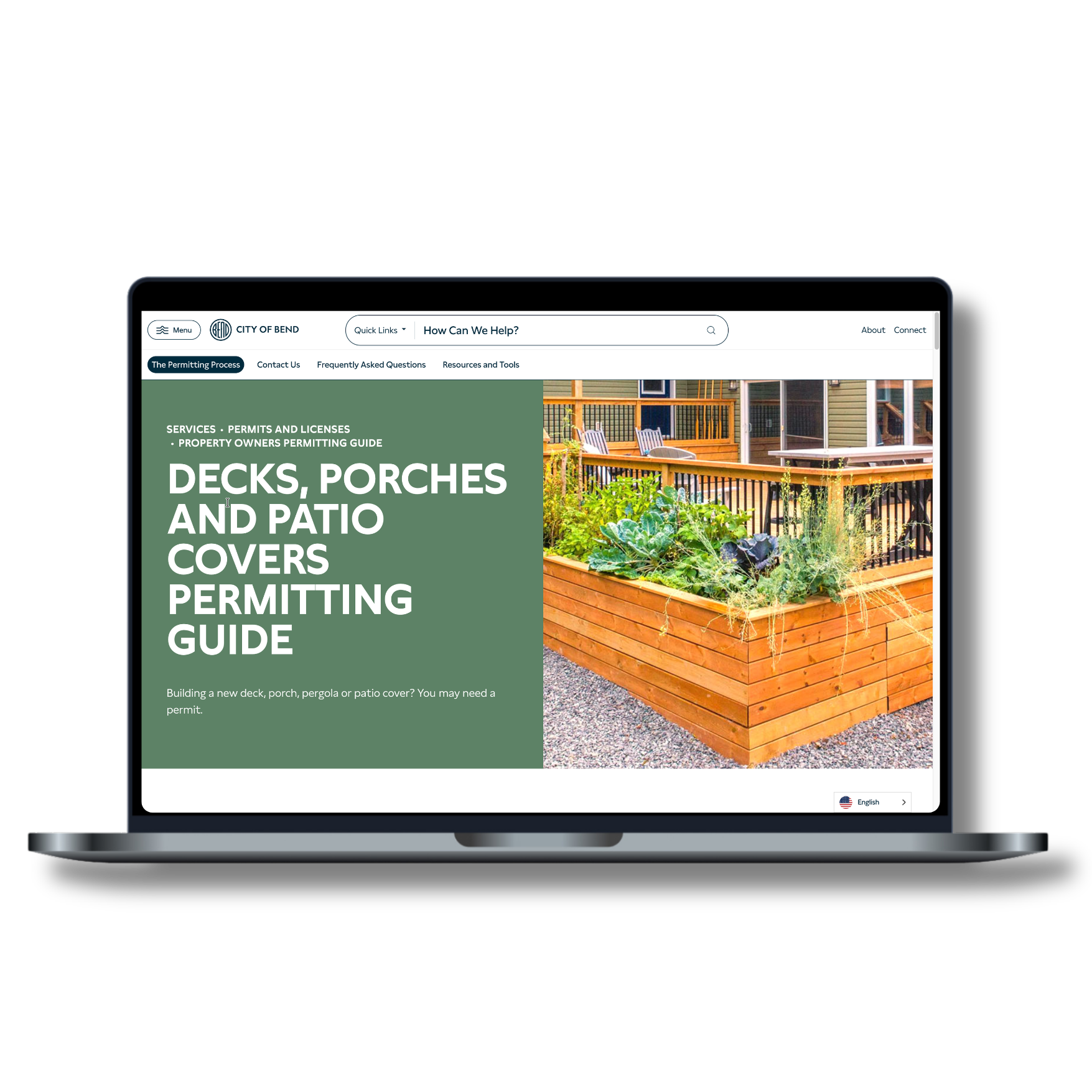
To build out the content for this proof-of-concept, I asked Microsoft Copilot to outline the permitting process in Bend, Oregon. The result gave us the end-to-end foundation we had been missing. I then asked Copilot for FAQs around permitting in Bend — and they tracked closely with what we had heard in our user research. Armed with this new content, I built a working concept for a Property Owners Permitting Guide. Through our stakeholder discovery sessions, we had also learned what the most common permit-requiring projects were, so I built out a concept for a project-specific page: Decks, Porches, and Patio Covers Permitting Guide.
Presenting to Stakeholders
With a new sitemap and a tangible proof-of-concept in hand, we presented to the department director and division managers. The response exceeded our expectations: the department director prioritized content reviews with subject matter experts across the department. It was a strong endorsement for the team and the direction we were heading.
Rebuilding the Information Architecture
With the green light from the department director, we continued building out content for the new pages. For existing content we determined would stay, we returned to Miro to map out each page using sticky notes, then grouped and reorganized them to align with identified user journeys.
Once the information architecture was cleaned up, we rewrote the content at an 8th-grade reading level—leaning on CoPilot to assist—to make it more accessible to the broader community. Updated content was then shared with the communications liaison for subject matter expert review and stakeholder approval before pages were built.
Results
The City's first end-to-end permitting guide. A Property Owners Permitting Guide, plus project-specific guides for the most common permit-requiring projects. Community Development subject matter experts reviewed and approved them, and the department now owns and maintains them.
Task-based navigation replaced org-chart navigation. Community members now start from the project they want to build, not from which division handles it.
Staff and community feedback on the updated pages has been positive. Next, we'll return to the guides with Community Development to measure whether they reduce the "where do I start?" questions frontline staff reported, and refine them from there.